Description
May 1978. Somebody used ARPANET to advertise computers to hundreds of network users.
The reaction is the part worth keeping.
This historical transcript preserves the Digital Equipment Corporation mass email commonly cited in histories of spam, along with the immediate MsgGroup discussion that followed. The participants were not looking back on the birth of Internet culture. They were living inside it and trying to decide, in real time, what electronic mail was supposed to be used for.
The argument rapidly moves beyond one advertisement. The messages discuss commercial access to a limited network, whether harvesting addresses from a network directory was abusive, whether advertising should be suppressed, whether regulation becomes censorship, whether users should govern themselves, and what might happen when similar electronic mail systems reached commercial networks.
What happened
DEC marketer Gary Thuerk wanted to promote demonstrations of the DECSYSTEM-2020, 2020T, 2060 and 2060T. The message advertised California presentations scheduled for May 9 and May 11, 1978 and emphasized ARPANET support under TOPS-20.
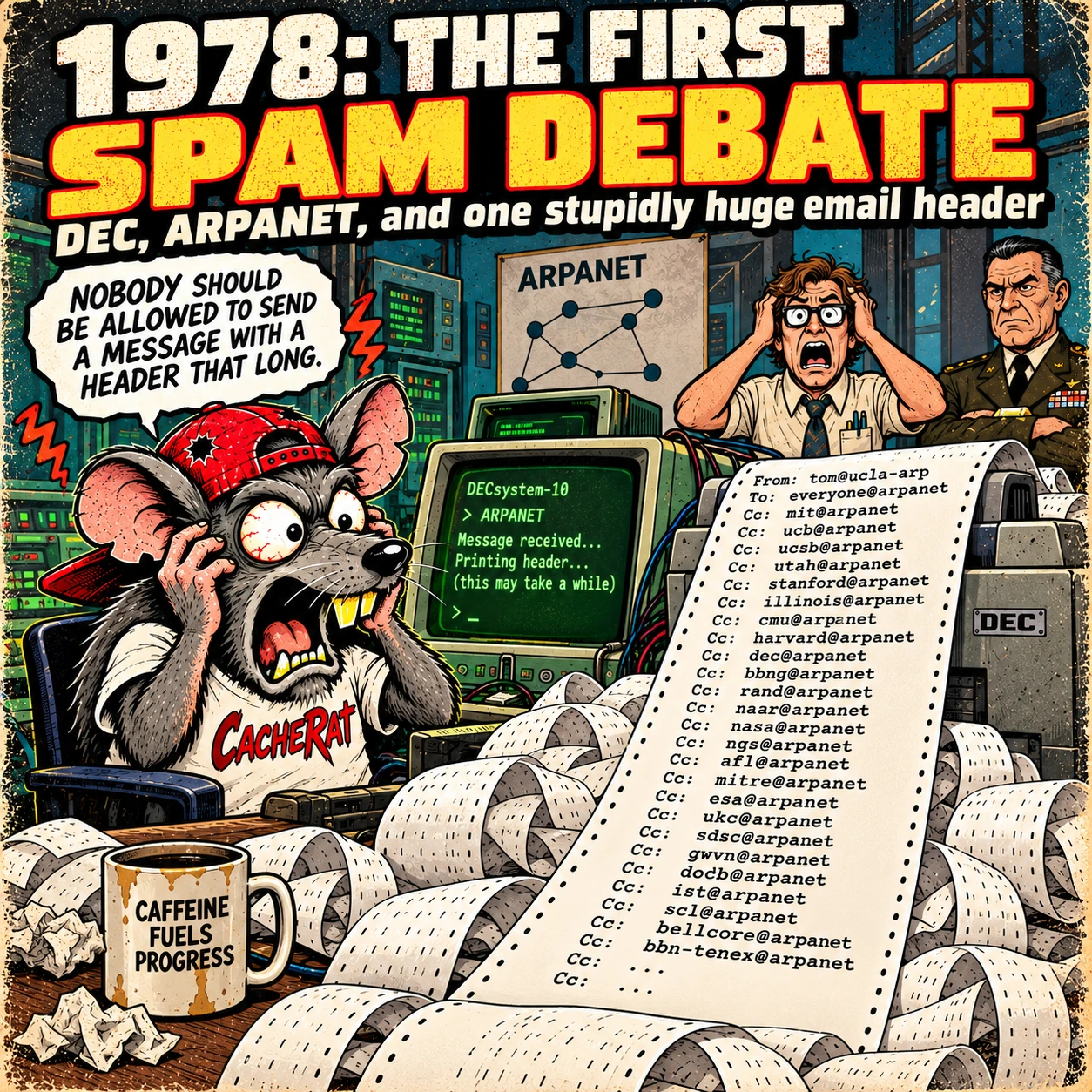
The mailing was assembled from ARPANET directory addresses. The source account describes a technical mess familiar to anyone who has ever pushed a mail system too hard: the SNDMSG address fields could not hold the full recipient list, addresses overflowed through the headers and into the message body, and the remaining recipients were later mailed again.
The Defense Communications Agency objected almost immediately, calling the commercial mailing a violation of ARPANET use policy. Then the network users started arguing.
Notable figures in the transcript
| Name | Why the name matters here |
|---|---|
| Gary Thuerk | DEC marketer identified as the sender behind the historic mass mailing. |
| Carl Gartley | DEC engineer involved in preparing and sending the message from Thuerk’s account. |
| Elizabeth “Jake” Feinler | ARPANET Network Information Center pioneer who argues about fairness, network access, self-governance and censorship. |
| Mark Crispin | Early network programmer who later became known for creating IMAP. His reply explicitly imagines junk mail on future commercial networks. |
| Richard M. Stallman | MIT AI Lab hacker who initially doubts the message would bother him, then changes his mind after seeing the enormous header. He later founded the GNU Project. |
| Einar Stefferud | Central MsgGroup figure whose commentary explains the SNDMSG/address-overflow mess and preserves context around the exchange. |
| Major Raymond Czahor | Chief of the ARPANET Management Branch at the Defense Communications Agency, whose formal complaint appears in the discussion. |
| Geoffrey S. Goodfellow | Participant who forwards the original DEC message back into the MsgGroup record. |
Lines worth preserving
“Nobody should be allowed to send a message with a header that long, no matter what it is about.”
— Richard M. Stallman, May 9, 1978
“I can envision junk mail being sent … and no way it could be prevented or stopped.”
— Mark Crispin, May 7, 1978
“I have heard some rumblings about ‘control’ and ‘censorship’ of the net by the powers-that-be…”
— Jake Feinler, May 7, 1978
“This was a flagrant violation of the use of ARPANET…”
— ARPANET Management Branch / DCA response, May 1978
Why it still matters
Read this now and the vocabulary is old, but the argument is not. The transcript touches problems that still sit underneath email spam, bulk messaging, social-network promotion, harvested contact lists, platform moderation, decentralized networks, bot traffic and user-controlled filtering.
One of the strongest passages comes from Mark Crispin, who distinguishes ARPANET from a future commercial network and predicts a situation where electronic junk mail might be impossible to prevent centrally. His proposed last line of defense is the user’s own delete command.
That is not a modern essay interpreting 1978. It is in the 1978 conversation.
What you get
- The supplied historical transcript packaged as a readable Markdown file.
- A README with provenance, dates, topic summary and the principal names in the discussion.
- Original message headers, recipient material, DEC advertisement text and reaction messages preserved in the supplied source.
Historical scope
Primary date range: May 1–10, 1978.
Subjects: ARPANET, early email, DEC / Digital Equipment Corporation, DECSYSTEM-20, TOPS-20, SNDMSG, MsgGroup, electronic advertising, spam history, acceptable-use policy, network governance, directory harvesting, censorship, filtering and early Internet culture.
Provenance and limits
This is a historical research/convenience package. It does not claim ownership of the underlying correspondence or pretend the source material is secret. The value here is having the surviving transcript packaged into a small, readable historical artifact with the surrounding context intact.