Description
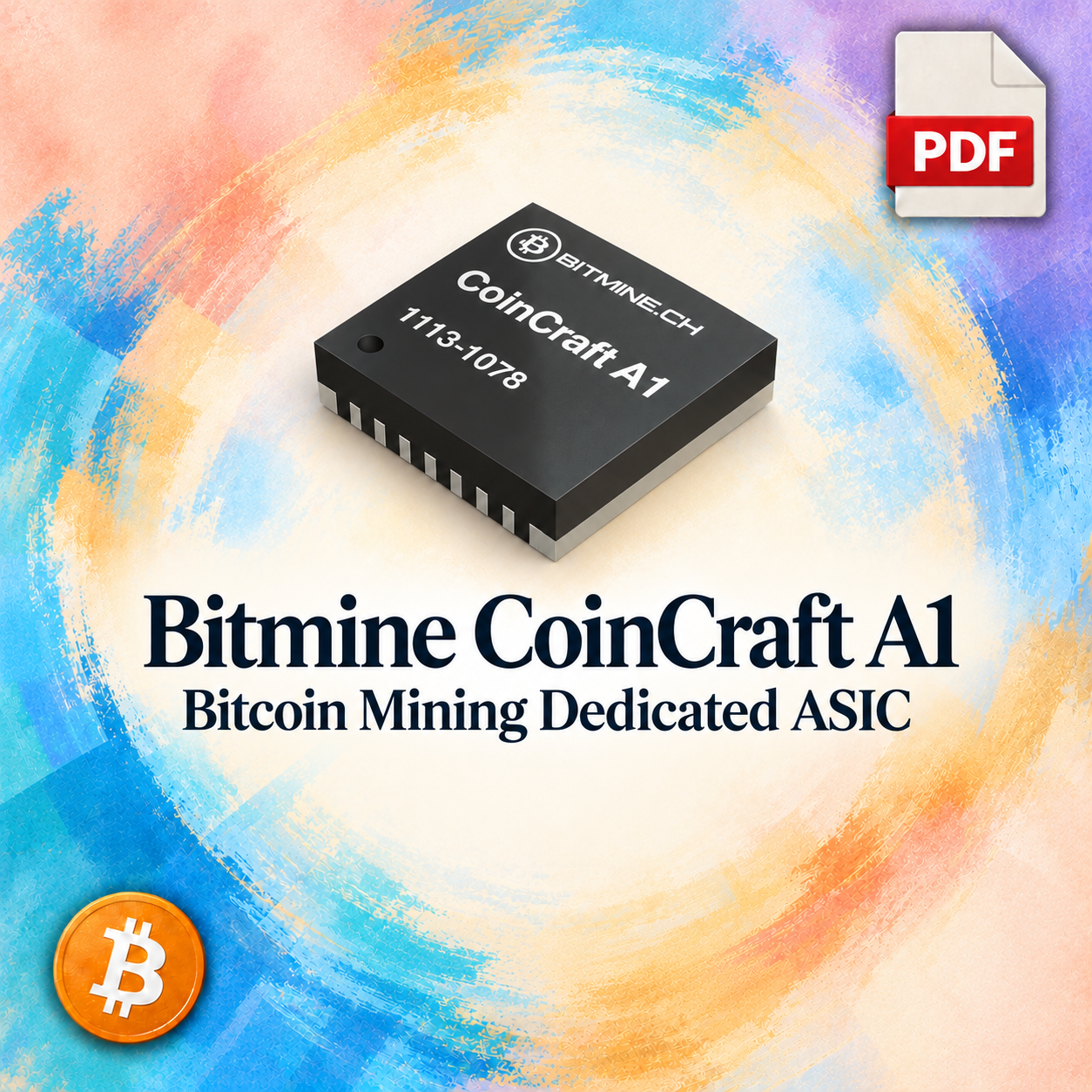
An old mining board with no documentation is a collection of very specific unanswered questions. Bitmine’s CoinCraft A1 reference gets down to the commands, registers and pins behind its Bitcoin mining chip.
This purchase reveals the PDF’s location in the public Internet Archive; you receive document.txt with the archive link and a short identification note, while the PDF itself is available at that source.
Source edition: Bitmine AG, 2013; 18 pages.
Inside the CoinCraft A1 reference
The document begins with the chip’s advertised operating modes and then moves into its SPI protocol. It describes communication through a chain of ASICs, how command and address fields are arranged, and how a controller directs work to individual chips or broadcasts it along the chain. These are the details that matter when comparing firmware behavior with the hardware underneath it.
Commands, registers and the firmware sequence
The command tables cover self-testing, resets, job submission, result retrieval and register access. A firmware implementation section follows the sequence from initialization through assigning work and reading returned nonces. The register reference explains configuration fields and the count of hashing engines that passed the built-in test. For someone examining old miner software, this provides a concrete vocabulary for the packets and numbers in front of them.
Pinout and operating constraints
Later sections document package connections, supply and clock specifications, and thermal behavior. The PDF is therefore useful beyond its headline hashing rate: it connects the control protocol with the physical chip. Treat every operating figure as a specification for this particular historical ASIC, rather than a setting to apply to unrelated mining equipment.
Who this suits
Hardware preservationists, embedded developers and Bitcoin mining historians get the most from this source. It assumes comfort with electronics and hexadecimal command fields. It is a chip reference, with a firmware implementation guide; it does not supply a complete miner repair procedure or promise that an old board can be restored.
What you receive
One plain-text file named document.txt containing the direct archive URL, the document title and a short description. You are paying for finding and identifying the source. The source PDF is not included in the purchased download. Internet Archive hosts the file independently; archive availability can change.